1.3.3How can I walk a distance graph?
The Slope Walk
MATCH-A-GRAPH
As your class is attempting to create slope walks, think about these questions:
What information does each graph represent?
What information is required to precisely match the graph?
What directions will you need to give a classmate so that they can match the graph?

Derive a method for walking the graph of each of the basic functions listed below. In each case the graph will represent distance versus time. Your goal is to get the basic shape of each graph, not to go through specific points. Analyze the graphs in any order.
For each function below:
Sketch the graph of
. Walk the sketch. Set the motion detector to record ten seconds worth of data.
Write a description of the walk including information about where to start, where to turn around and when to “speed up” or “slow down”.
Describe how walking the graphs of
, , and will be similar and different. Christian walked
and C.J. walked . How were their walks the same? How were their walks different? Christian walked
and Ara walked . Who had the greatest speed at the beginning? Who had the greatest speed at the end?

Carefully graph the function
Iveta wants to calculate the area under the curve for
, so she decides to divide the region into ten trapezoids to approximate the area. Explain to Iveta why this is not the most efficient method. Calculate the area under the curve for
.
Identify the domain and range of each of the functions below. Then write a possible piecewise-defined function for each graph. Homework Help ✎
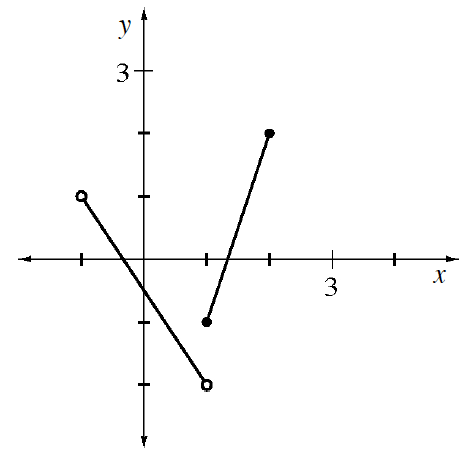
.png)
Let
While studying the finite differences of a particular function, Neo noticed that the differences changed linearly. What can you tell him about the original function? Also, how do his finite differences change? Homework Help ✎
Let:
State the domain of
. Solve for
if . Explain why
does not have an inverse that is a function.
Examine two ways a line changes: Homework Help ✎
Sketch
. What are ? How are the function values changing as increases? Calculate the area under the curve for
if . How is the area changing as increases?
For each graph below, state the intervals where the function is increasing and decreasing. Homework Help ✎
.png)
.png)
For part (a) on the interval in which the function is decreasing, is the rate of decrease constant? How do you know?